
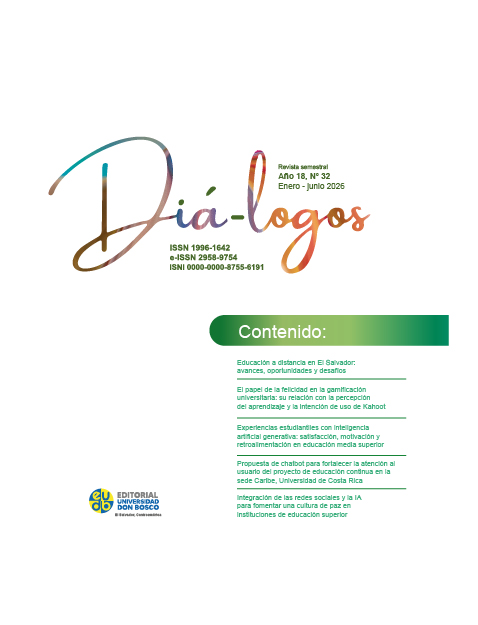
El papel de la felicidad en la gamificación universitaria: su relación con la percepción del aprendizaje y la intención de uso de Kahoot
DOI:
https://doi.org/10.61604/dl.v18i32.452Palabras clave:
Educación superior, innovación educativa, tecnología educativa, actitudes estudiantiles, bienestar emocional, aprendizaje basado en juegosResumen
La gamificación se ha consolidado como una estrategia para mejorar la participación y el aprendizaje en educación superior; sin embargo, aún se desconoce en qué medida el bienestar emocional de los estudiantes se relaciona con su experiencia con herramientas gamificadas. Este estudio tiene como objetivo analizar la relación entre la felicidad y la percepción del aprendizaje, así como examinar el papel de variables como la ansiedad, la presión de tiempo y el FOMO en entornos gamificados. Para ello, se aplicó una encuesta a 127 estudiantes universitarios y se realizaron análisis de varianza (ANOVA) y pruebas de correlación con el fin de evaluar diferencias entre grupos según su nivel de felicidad y determinar los factores asociados a la intención de uso futuro. Los resultados muestran que los estudiantes con mayores niveles de felicidad perciben un mayor aprendizaje mediante gamificación en comparación con aquellos con menor bienestar, lo que respalda la teoría de la ampliación y construcción de las emociones positivas; sin embargo, no se observaron diferencias significativas en ansiedad, presión de tiempo o FOMO en función del nivel de felicidad. A diferencia de estudios previos centrados principalmente en la utilidad de Kahoot o en los efectos generales de la gamificación, este trabajo examina el papel del bienestar emocional situacional en la percepción del aprendizaje y en la aceptación futura de la herramienta.
Descargas
Citas
Ajzen, I. (1991). The theory of planned behavior. Organizational Behavior and Human Decision Processes, 50(2), 179–211. https://doi.org/10.1016/0749-5978(91)90020-T
Alt, D. (2018). Students’ well-being, fear of missing out, and social media engagement for leisure in higher education learning environments. Current Psychology, 37(1), 128–138. https://doi.org/10.1007/s12144-016-9496-1
Baker, Z. G., Krieger, H., & LeRoy, A. S. (2016). Fear of missing out: Relationships with depression, mindfulness, and physical symptoms. Translational Issues in Psychological Science, 2(3), 275–282. https://doi.org/10.1037/tps0000075
Buckley, P., & Doyle, E. (2016). Gamification and student motivation. Interactive Learning Environments, 24(6), 1162–1175. https://doi.org/10.1080/10494820.2014.964263
Chan, E., Nah, F. F. H., Liu, Q., & Lu, Z. (2018). Effect of gamification on intrinsic motivation. In HCI in Business, Government, and Organizations: 5th International Conference, HCIBGO 2018, Held as Part of HCI International 2018, Las Vegas, NV, USA, July 15-20, 2018, Proceedings 5 (pp. 445-454). Springer International Publishing.
Cheong, C., Cheong, F., & Filippou, J. (2013). Quick quiz: A gamified approach for enhancing learning. In PACIS 2013 Proceedings. 206. http://aisel.aisnet.org/pacis2013/206
Cohen, J. (1988). Statistical power analysis for the behavioral sciences (2nd ed.). Lawrence Erlbaum Associates.
Davis, F. D. (1989). Perceived usefulness, perceived ease of use, and user acceptance of information technology. MIS Quarterly, 13(3), 319–340. https://doi.org/10.2307/249008
Deterding, S., Dixon, D., Khaled, R., & Nacke, L. (2011, September). From game design elements to gamefulness: defining" gamification". In Proceedings of the 15th international academic MindTrek conference: Envisioning future media environments (pp. 9-15). https://doi.org/10.1145/2181037.2181040
Dichev, C., & Dicheva, D. (2017). Gamifying education: what is known, what is believed and what remains uncertain: a critical review. International journal of educational technology in higher education, 14, 1-36. https://doi.org/10.1186/s41239-017-0042-5
D'Mello, S., Dieterle, E., & Duckworth, A. (2017). Advanced, analytic, automated (AAA) measurement of engagement during learning. Educational psychologist, 52(2), 104-123. https://doi.org/10.1080/00461520.2017.1281747
Field, A. (2013). Discovering statistics using IBM SPSS statistics (4th ed.). SAGE Publications.
Fredrickson, B. L. (2001). The role of positive emotions in positive psychology: The broaden-and-build theory of positive emotions. American psychologist, 56(3), 218-226. https://doi.org/10.1037/0003-066X.56.3.218
Fredrickson, B. L., & Joiner, T. (2002). Positive emotions trigger upward spirals toward emotional well-being. Psychological science, 13(2), 172-175. https://doi.org/10.1111/1467-9280.00431
Hamari, J., & Koivisto, J. (2015). “Working out for likes”: An empirical study on social influence in exercise gamification. Computers in human behavior, 50, 333-347. https://doi.org/10.1016/j.chb.2015.04.018
Hanus, M. D., & Fox, J. (2015). Assessing the effects of gamification in the classroom: A longitudinal study on intrinsic motivation, social comparison, satisfaction, effort, and academic performance. Computers & education, 80, 152-161. https://doi.org/10.1016/j.compedu.2014.08.019
Kari, T., Piippo, J., Frank, L., Makkonen, M., & Moilanen, P. (2016). To gamify or not to gamify? Gamification in exercise applications and its role in impacting exercise motivation. In BLED 2016 Proceedings. 20. https://aisel.aisnet.org/bled2016/20
Koivisto, J., & Hamari, J. (2019). The rise of motivational information systems: A review of gamification research. International journal of information management, 45, 191-210. https://doi.org/10.1016/j.ijinfomgt.2018.10.013
Kotler, P., & Lee, N. (2015). Social marketing: Changing behaviors for good. SAGE Publications, Incorporated.
Lampropoulos, G., & Sidiropoulos, A. (2024). Impact of gamification on students’ learning outcomes and academic performance: A longitudinal study comparing online, traditional, and gamified learning. Education Sciences, 14(4), 367. https://doi.org/10.3390/educsci14040367
Lazarus, R. S., & Folkman, S. (1984). Stress, appraisal, and coping. Springer publishing company.
Licorish, S. A., Owen, H. E., Daniel, B., & George, J. L. (2018). Students’ perception of Kahoot!’s influence on teaching and learning. Research and Practice in Technology Enhanced Learning, 13(1), 1-23. https://doi.org/10.1186/s41039-018-0078-8
Lyubomirsky, S., & Lepper, H. S. (1999). A measure of subjective happiness: Preliminary reliability and construct validation. Social Indicators Research, 46(2), 137–155. https://doi.org/10.1023/A:1006824100041
Manzano-León, A., Camacho-Lazarraga, P., Guerrero, M. A., Guerrero-Puerta, L., Aguilar-Parra, J. M., Trigueros, R., & Alias, A. (2021). Between level up and game over: A systematic literature review of gamification in education. Sustainability, 13(4), 2247. https://doi.org/10.3390/su13042247
Nunnally, J. C., & Bernstein, I. H. (1994). Psychometric theory (3rd ed.). McGraw-Hill.
Przybylski, A. K., Murayama, K., DeHaan, C. R., & Gladwell, V. (2013). Motivational, emotional, and behavioral correlates of fear of missing out. Computers in human behavior, 29(4), 1841-1848. https://doi.org/10.1016/j.chb.2013.02.014
Richard, N. L., Kristina, N. B., & Rachel, C. C. (2017). Gamification of task performance with leaderboards: A goal setting experiment. Journal of Computers in Human Behaviour, 71, 508-515. https://doi.org/10.1016/j.chb.2015.08.008
Ryan, R. M., & Deci, E. L. (2000). Self-determination theory and the facilitation of intrinsic motivation, social development, and well-being. American psychologist, 55(1), 68. https://doi.org/10.1037/0003-066X.55.1.68
Salanova, M., Bakker, A. B., & Llorens, S. (2006). Flow at work: Evidence for an upward spiral of personal and organizational resources. Journal of Happiness studies, 7(1), 1-22. https://doi.org/10.1007/s10902-005-8854-8
Sailer, M., Hense, J. U., Mayr, S. K., & Mandl, H. (2017). How gamification motivates: An experimental study of the effects of specific game design elements on psychological need satisfaction. Computers in human behavior, 69, 371-380. https://doi.org/10.1016/j.chb.2016.12.033
Schaufeli, W. B., Salanova, M., González-Romá, V., & Bakker, A. B. (2002). The measurement of engagement and burnout: A two sample confirmatory factor analytic approach. Journal of Happiness studies, 3, 71-92. https://doi.org/10.1023/A:1015630930326
Schöbel, S., Saqr, M., & Janson, A. (2021). Two decades of game concepts in digital learning environments–A bibliometric study and research agenda. Computers & Education, 173, 104296. https://doi.org/10.1016/j.compedu.2021.104296
Schunk, D. H., & DiBenedetto, M. K. (2020). Motivation and social cognitive theory. Contemporary Educational Psychology, 60, 101832. https://doi.org/10.1016/j.cedpsych.2019.101832
Subhash, S., & Cudney, E. A. (2018). Gamified learning in higher education: A systematic review of the literature. Computers in human behavior, 87, 192-206. https://doi.org/10.1016/j.chb.2018.05.028
Tomas, L., Evans, N. S., Doyle, T., & Skamp, K. (2019). Are first year students ready for a flipped classroom? A case for a flipped learning continuum. International Journal of Educational Technology in Higher Education, 16(1), 1-22. https://doi.org/10.1186/s41239-019-0135-4
Wang, A. I. (2015). The wear out effect of a game-based student response system. Computers & Education, 82, 217-227. https://doi.org/10.1016/j.compedu.2014.11.004
Wang, A. I., & Tahir, R. (2020). The effect of using Kahoot! for learning–A literature review. Computers & Education, 149, 103818. https://doi.org/10.1016/j.compedu.2020.103818
Descargas
Publicado
Cómo citar
Número
Sección
Licencia

Esta obra está bajo una licencia internacional Creative Commons Atribución-NoComercial-SinDerivadas 4.0.