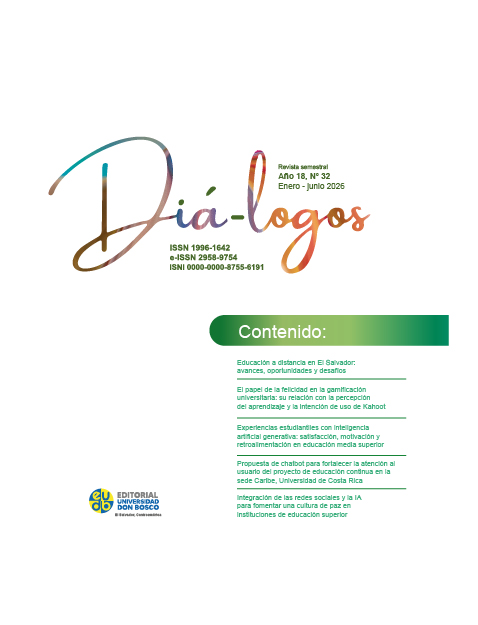
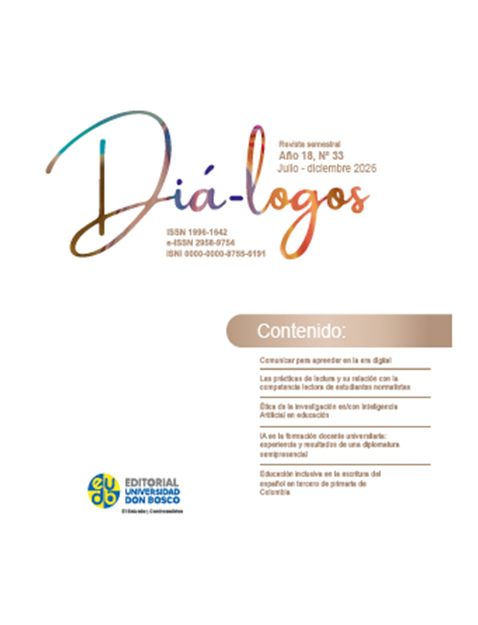
Reading Practices and Their Relationship to the Reading Proficiency of Teacher Education Students
DOI:
https://doi.org/10.61604/dl.v18i33.565Keywords:
Reading practicies, reading proficiency, teacher trainingAbstract
Reading, the act of reading, one’s relationship with reading, and reading proficiency are closely interrelated concepts. Hence the need to study, examine, and reflect on them. This study focuses on analyzing the perceptions and assessments that teacher-candidates have regarding their reading proficiency. It arises from the question: How do teacher-candidates perceive their reading practices and habits, and how do these influence their own reading development? A qualitative approach using the phenomenological method was employed. A four-section questionnaire was administered to 25 students in the Bachelor’s degree program in Preschool Education. The results indicate that the students have limited reading practices, although they employ strategies that allow them to deepen their reading process. This information is essential for understanding how the students perceive their relationship with the text, as well as their reading actions, strategies, skills, and assessments.
Downloads
References
Acevedo, A., et al. (2016). Innovación en las estrategias de lectura y su incidencia en la competencia lectora. Educación y ciencia, (19). DOI:10.19053/01207105.7768
Albert, M. (2007). La Investigación Educativa: Claves teóricas. McGRAW-HILL.
Barthes, R. (1994). El susurro del lenguaje. Paidós.
Bisquerra, R. (2009). Metodología de la Investigación Educativa. La Muralla.
González, Y. (2011). Configuraciones de las prácticas lectoras en contextos sociales. La lectura situada en la escuela y el trabajo. Perfiles educativos, (133)33. DOI:.22201/iisue.24486167e.2011.133.27903
Hernández, R., et al. (2014). Metodología de la investigación. McGraw-Hill.
Lerner, D. (2001). Leer y escribir en la escuela. FCE.
Manguel, A. (1996). Historia de la lectura. Siglo XXI.
Orozco, M. y Perez, L. (2007). El triángulo “L” en México: lectura, literatura y literacidad.
Pérez, P. y Zayas, F. (2007). Competencia en comunicación lingüística. Alianza.
Pérez, V., et al. (2018). El hábito de la lectura: una necesidad impostergable en el estudiante de ciencias de la educación. Revista Universidad y Sociedad, (3)10. https://rus.ucf.edu.cu/index.php/rus/article/view/926
Petit, M. (2015). Leer el mundo Experiencias actuales de transmisión cultural. FCE.
Rose, D., y Martin, R. (2018). Leer para aprender. Lectura y escritura en las áreas del currículo. Pirámide.
Ramírez, E. (2009). ¿Qué es leer? ¿Qué es la lectura? Investigación bibliotecológica, (23) 47.
Solé, I. (2012). Competencia lectora y aprendizaje. Revista Iberoamericana de Educación, (59). https://rieoei.org/historico/documentos/rie59a02.pdf
Downloads
Published
How to Cite
Issue
Section
License

This work is licensed under a Creative Commons Attribution-NonCommercial-NoDerivatives 4.0 International License.